Customer Feedback After One Year of Living
In the Flügelhaus, where the entire house becomes one large room when the
sliding doors are opened, there are no rooms in the traditional sense.
Even the bathroom is glass-walled, so the only private space is the toilet.
My eldest daughter was asked by her friends, "Do you have your own
room?" and she replied, "I don't have a room, but I have space."
It's been a year since we moved into this house. Mr. Tsukahara's design,
with its simple yet dynamic use of space, has completely transformed our
lifestyle. This house contains various elements that make us rethink our
lives.
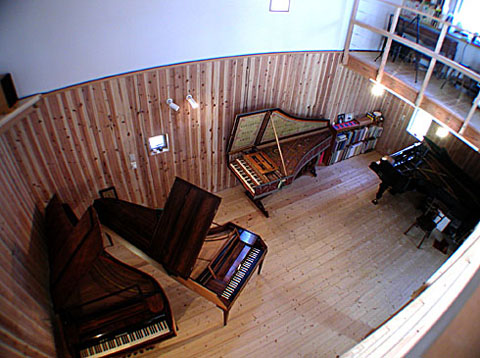
As musicians of historical keyboard instruments, my husband and I first examined the acoustics of our instruments after moving in. The music space is completely open to the second floor, so the harpsichord and fortepiano resonate exceptionally well. The flooring is made of European spruce, the same material as the soundboard. A harpsichord maker who came to see the instrument commented that the floor also resonated well. This resonance has made it possible to practice listening carefully to the space between notes, which has greatly changed how we create our musical ideas. This reminds me of the feeling of practice I experienced while studying abroad. This is something unthinkable before, as we were forced to practice in a typical Japanese house with a low ceiling and no acoustics.
Being a listener is also exceptional. When we open the sliding doors that create the music space and look up at the second-floor living space and loft from the music space, it looks like the balcony of an opera house. Depending on the location, the sound of the instruments themselves can be heard directly, or it can emanate with a fragrance accompanied by resonance, creating a rich variety.
Visually, we are also enjoying a sense of something we have never experienced before. Since there are hardly any walls dividing the house, we can basically see the entire house from anywhere. Before moving in, we had never imagined living in a place where everything is exposed, so this was enough to completely change our way of life. However, blind spots are created from various angles of sight, so we are still figuring out the placement of furniture and household items by moving our gaze in three dimensions—up, down, left, right, front, and back—to consider what is visible and what is not, and how to show and hide things. This is an etude for living aesthetically while still retaining a sense of everyday life. It's
not just the sight that is interesting in this large, open space. The movement of light is also fascinating. The sunlight, changing with the seasons, moves dynamically throughout the house, like a sundial. The way the moonlight rising from the east softly illuminates the harpsichord on the west wall evokes the sound of Debussy's "The Audience Terrace Bathed in Moonlight." However, in midsummer, the sun moves further north than expected, and I was surprised to find it directly hitting the wardrobe, which I had placed as far north as possible to avoid direct sunlight.
There are also some fun extras that have come from this music-centered design. To block the sunlight that was directly hitting the instruments, we sealed off the entire south side of the music space, which occupies the western half of the house, resulting in a large white wall. Mr. Tsukahara and I asked the construction company if it would be possible to watch movies from the indoor balcony on the north side. They modified the railing to be foldable, and we realized a movie theater that can show films after sunset. We invited seminar students over to watch "Some Like It Hot," which they loved, and we also used it to take the kids to examine Muska in close-up during the collapse of Laputa.
It was Mr. Tsukahara's design skills and spatial awareness that made all these diverse
and exciting experiences possible. The conditions we initially set at the
start of the design process were quite challenging. We wanted a space that
could accommodate five historical keyboard instruments, have good acoustics,
and even host small concerts if necessary. We wanted to avoid separating
music from daily life too much. We had very limited borrowing from the
bank, so we wanted a low-cost project. We wanted the design to take advantage
of the view overlooking the bay. We wanted to live in a beautiful house
like the ones on the professor's website. Faced with these seemingly impossible
demands, after three or four discussions, the professor suddenly presented
us with the current plan. "What? There's no entrance!" We were
stunned. "The whole house is one room, wow, with no walls, it's just
like Terayama's lemmings!" we exclaimed excitedly, making irrelevant
comments, but the use of space was so interesting that we quickly forgot
about the entrance and became completely engrossed in the plan. The feeling
of awe we felt then remains unchanged even now, a year later.
As we savor the immense happiness we feel in this little house, we raise a beer to Professor Tsukahara in Osaka from the rooftop overlooking the bay. Thank you, Professor Tsukahara.
We had asked a Flügel House homeowner for their feedback on their home,
and we received the above email. We are truly grateful for this email.
We hope to hear from you occasionally in the future to see how you enjoy
your home. Thank you for your continued support.
Tsukahara Architectural Design Office
Hidenori Tsukahara |
|
|
|
|
 |







